For the last 40 years, I’ve pretty much just enjoyed market declines. Especially in the early days I had very little invested, so even a huge percentage change was a pretty small amount of money to me. That made it easy to simply enjoy the drama—all the serious people running in circles, screaming and shouting.
I have been known many times to say, “If the weather can’t be good, it should at least be bad enough to be interesting.” Big market moves have historically engendered the same kind of feelings in me.
Even the last big decline, the Great Financial Crisis—which happened right after I’d retired, prompting a good measure of black humor (“I wouldn’t want to be someone who’d just retired, right before his stock market portfolio took a 40% hit!”)—didn’t keep me from being able to enjoy the journey.
Today’s decline is not different. At least, it’s not yet different.
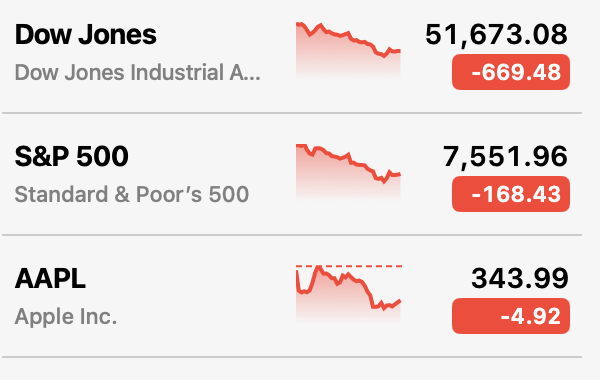
A big part of why I could enjoy the early declines was that I had a regular income, with a tidy chunk going into the markets. To a person in that situation, a big decline in stock prices is a big sale. All the stocks just got cheaper to buy.
Now that I’m long retired, that is less true.
As I say, the main reason I’ve long been interested in big declines is that they’re interesting. This one is perhaps more interesting than most, because this could be the AI bubble popping.
Let me be clear that it is much too early to announce that this is the AI bubble popping. It is entirely possible that the markets will take this as a “brief correction” and then zoom off to even more absurd heights before the bubble pops. And it is also not certain that the bubble will pop in any kind of dramatic way. Sometimes these things just work themselves out, with the over-extended stocks pulling back gradually over a few years while other stocks go up, in a way that never produces a dramatic crash to point at.
One thing I do want to observe is this by Paul Krugman:
“… it’s increasingly difficult to see how the hyperscalers can realize their gargantuan investment plans unless someone is willing to take massive losses.”
And there will be massive loses. I mean, even if everybody went “You know, maybe we don’t want to spend so much on data centers,” and quit borrowing and spending, there’s quite a bit of debt that’s not going to get paid back. But if they go on borrowing and spending, there’s going to be a gargantuan amount of debt that isn’t going to get paid back.
Who loses all that money?
Well, to begin with, the people who lent the money to people who couldn’t pay it back. There are also people who guaranteed that debt in various ways; they should be on the hook as well. But we know from the great financial crisis that it won’t be only (or even primarily) the lenders. During the Great Financial Crisis, the banks (who made horrible, terrible, no good mortgage loans to people who had no hope of ever paying the money back) were protected. Instead, the home owners got absolutely screwed by the banks, by the governments, and by the courts.
And this time around, we won’t have home owners to put on the hook for it. The money has been borrowed by Special Purpose Vehicles—companies whose only purpose is to borrow money to fund some activity (such as building a data center), while keeping the borrowing off the books of the big companies who want to use the data centers to run AI models.
The special purpose vehicles will be screwed, which is exactly their purpose. Unfortunately, that doesn’t help, because the companies who loaned the money, and the companies who guaranteed the money (such as by promising to pay to run their models at the data center built by that SPV) are all kind of important to the economy. As I say, the whole purpose of the SPV was that it (and the people who loaned it money) get screwed. But that’s only okay if it’s just the random SPV here and there. If they all go down, then the whole AI sector goes down, and that’s half the stock market at this point.
That observation, along with Paul Krugman’s observation, got me wondering: Who might be stuck with the massive losses?
I mentioned the question to my brother, who suggested it’d be “Mom & Pop who bought mutual funds for their retirements.”
I think that’s exactly right. They’re going to try to stick it to the Boomers. That’s the only group that has the money to cover those losses. (Except for the billionaires, and the whole point is to make sure they don’t have to take it on the chin.)
That somewhat changes my perspective on big declines in the stock market.
