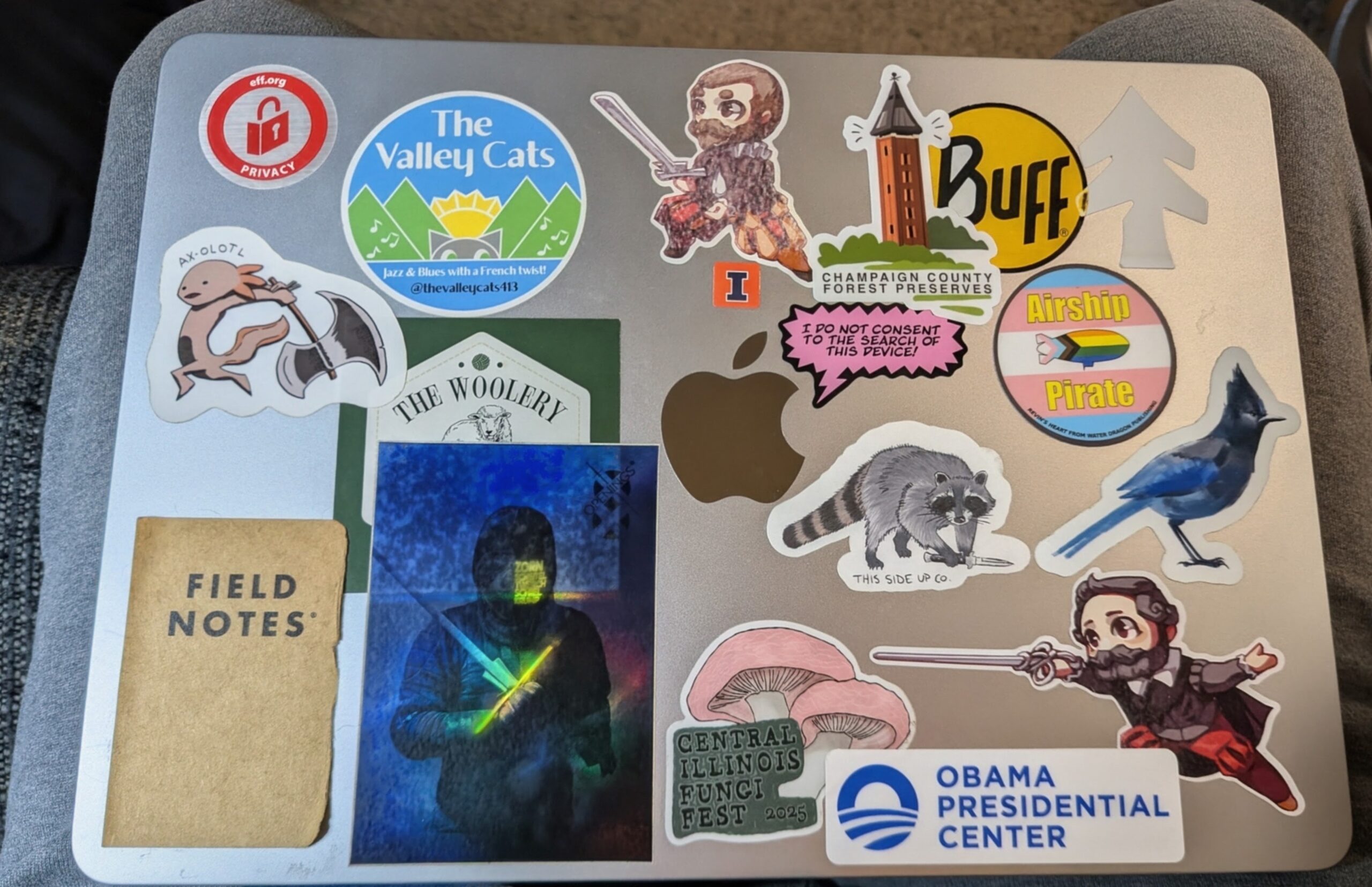
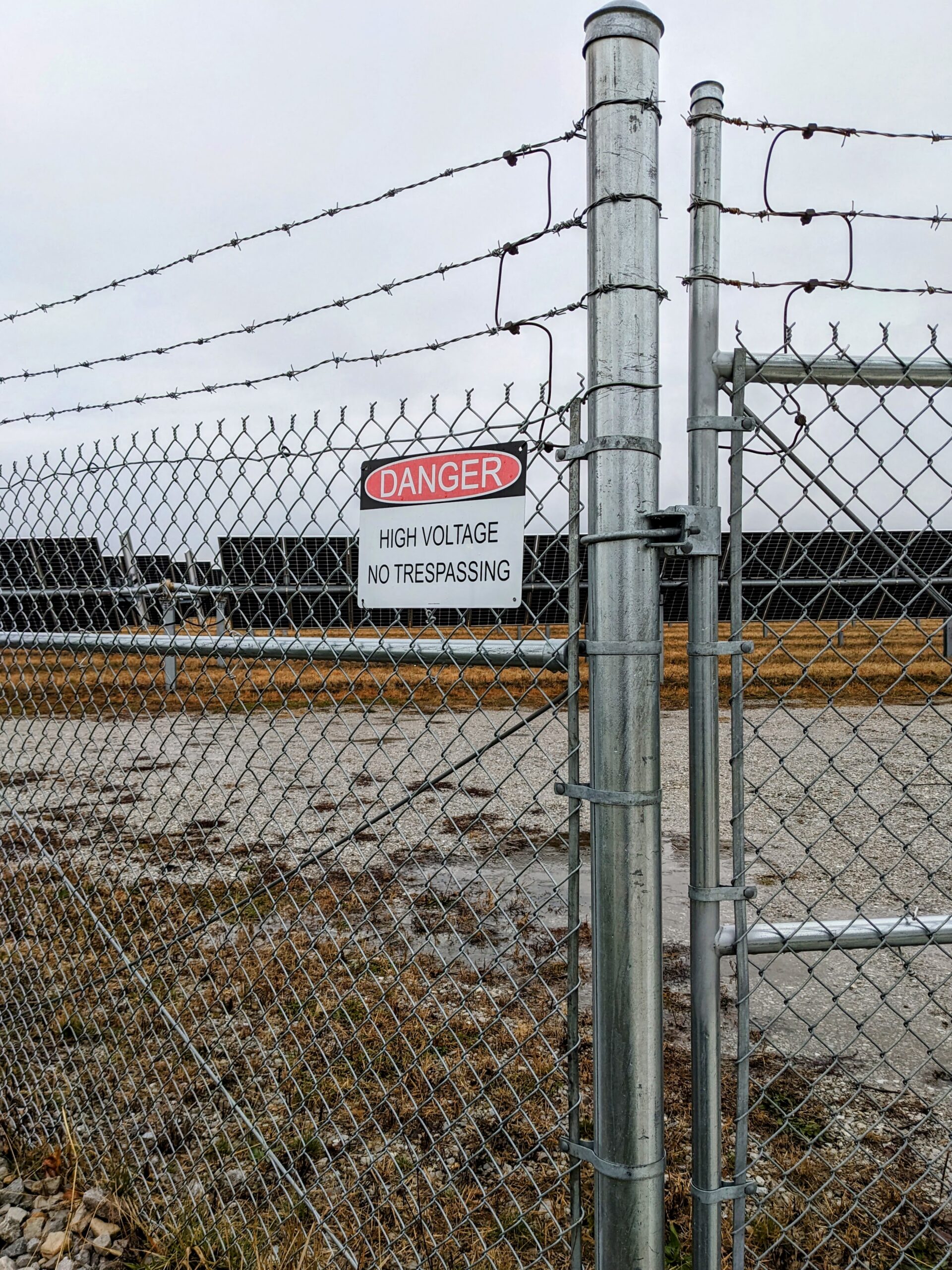
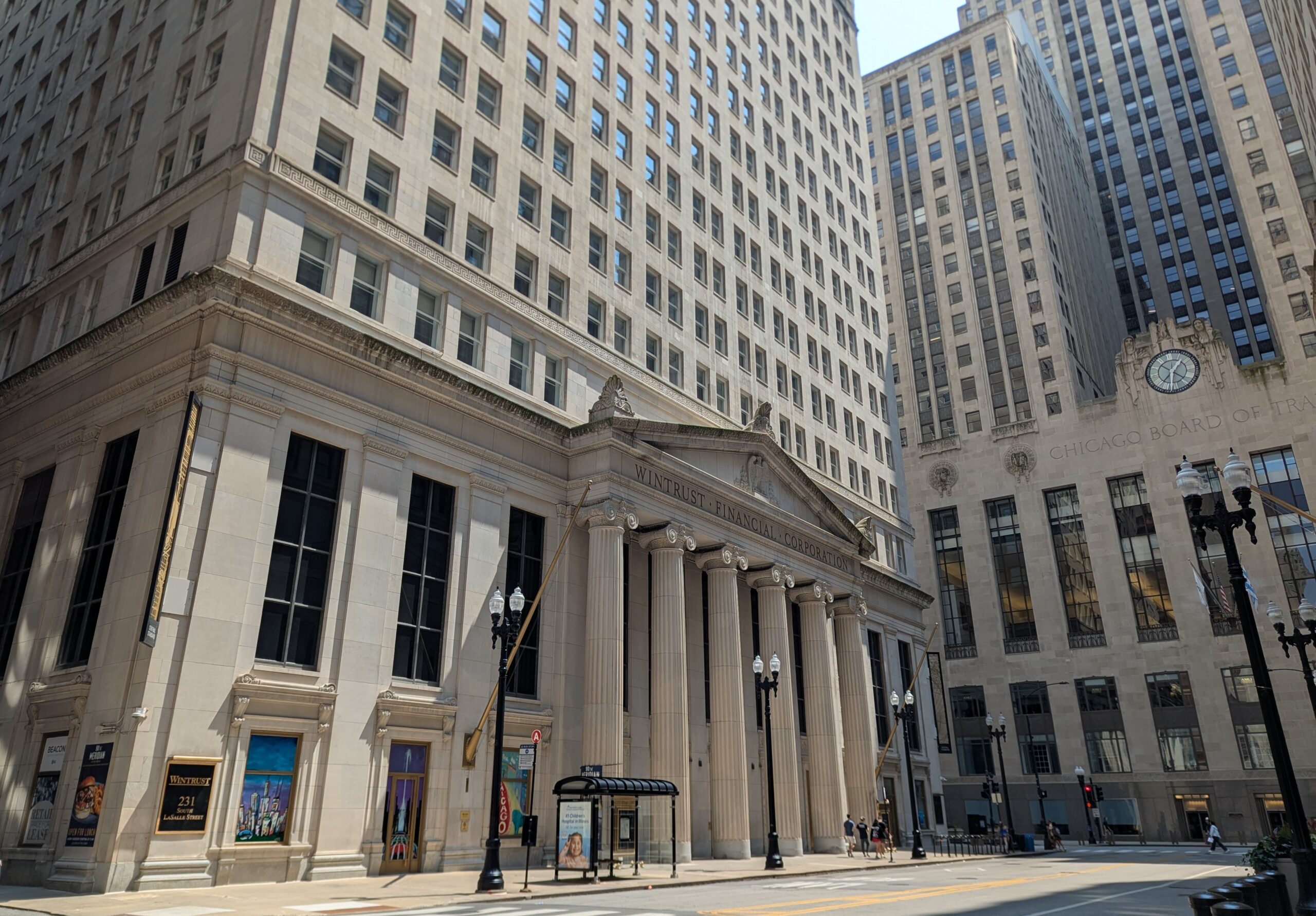
The new ones are the Champaign County Forest Preserve District sticker a bit right of center at the top, and the Obama Presidential Center sticker a bit right of center at the bottom.
We got the former by attending the Whiskey Walk at Buffalo Trace Prairie on Sunday. That was wonderful great fun. A nice walk, lots of whiskeys to taste (and some non-whiskeys as well). I ran into three former coworkers and got to catch up with them—a fun treat. And there were several dogs including a very well-behaved golden retriever who was (very inappropriately) running off-leash—a fact that didn’t seem to bother anybody.
Jackie got the latter when she and her friend Rosie went to the Obama Center on a trip to Chicago (and gave the sticker to me, because she knows I like to put stickers on my laptop).
Many websites have started running some sort of “human-verification” script before showing the content. I don’t know what’s going on behind the scenes (these seem to be much simpler than a captcha); I assume they’re just running some script that AI content scrapers don’t support, and if you don’t let the script run, they assume you’re a content scraper and don’t show you the content.
The problem is that I don’t let random scripts from third-party sites run on my machine.
This is primarily a security measure on my part. Secondarily, it also blocks most advertising. (I don’t really care about the ads themselves; I primarily object to the risk that random scripts will do something malicious on my machine. It’s still nice to avoid the ads.)
Yesterday there were three different pages that I tried to look at that didn’t load, because I wouldn’t let the “are you a human” scripts run.
That made me a little sad, but not sad enough to let random scripts run on my machine. Maybe I missed reading a really interesting post. But there are many, many interesting posts out there. I don’t have time to read even a tiny fraction of the things I’d find very interesting, so I’m generally unwilling to put much effort into getting to any particular post.
If that post is your post. . . . Either post it so I can see it, or just accept that it will go unread by me. I’ll be okay either way.
This is rather the opposite problem of the one my brother recently posted about: a talk we attended, where SFWA brought in several people to talk about the problem of detecting AI-written manuscripts.
Most of the people in the audience were writers, so of course there was roughly equal concern about false positives (falsely identifying actual human-written manuscripts as AI) as there was about false negatives (failing to identify an AI-written manuscript as AI). No one wants their work to get turned away because people assume it was written by a bot, and of course a single false accusation could ruin not only all hopes of a particular work seeing success, but ruin an entire career.
I’m not worried about AI killing us all, but I’m rather annoyed by people using AI to make my life worse in various ways, and by people who worry about AI making my life worse in these other ways.
Having said that…. Jackie bought this stool perhaps a decade ago, to use for sitting at her spinning wheel. Turned out, she really liked it, and has used it for all manner of sitting since then—any textile arts activity (weaving, etc.), but also just sitting at the dining table.
She shellacked it herself, having decided on shellac because it is so non-toxic, compared to pretty much any other wood finish.
Over the past ten years or so, the shellac wore along the front edge of the stool, and it got scuffed up in various places. She’s been complaining about this for a while now, and I bought a fresh can of shellac and some sandpaper, so she could fix it. Just lately she’s been complaining that the front edge was getting kind of splintery, where the wood had worn, after the shellac wore away.
It took a while, but I eventually understood that she was hoping that I would and go ahead and refinish her stool for her. (I’d thought that, since she’d done it herself in the first place, she’d have a proprietary interest in doing it again herself. Turns out, no.)
Today she complained again about how the splinters were catching not only on her clothes, but also on her skin. So I said, “Right! I’ll fix it!”
It took a while to track down the sandpaper, but once I had that, the smoothing off of the splintery bits went very quickly. Then I opened the can of shellac and brushed it on.
The directions say to wait an hour, sand it again, and then give it another coat. I’m sure that would be a great idea, but I’m not at all sure that I’ll do so. It’s actually looking pretty good with just one more coat over the coat Jackie gave it 10 years ago.
So now I am feeling very handy. Handy enough to feel somewhat manly as well.
I hesitate to take a victory lap regarding my predictions for the Iran conflict, and my predictions for the harms produced by AI. This post is just to say: I stand by what I have been saying.
With a bit of commentary, here’s the posts I’m standing by:
Things are amazingly more bad than markets seem to think The fact that a considerable amount of oil is now getting through might make this seem less worrisome, but I continue to stand by my analysis. Oil is getting through at great risk, and at huge cost. I don’t see any scenario where this gets better any time soon.
“Exit through the state” could fail The single exception is that the AI tech bros could convince the government to pay them billions in taxpayer dollars to prevent a stock market collapse after the AI bubble bursts. That would be very bad, but I’m slightly hopeful we can avoid that scenario.
Prepare yourself for the pop of the AI bubble My argument that there is an AI bubble, and that it’s one of the bad sorts (where very little of enduring value gets built, and the whole thing is financed with a lot of leverage that’s hard to analyze).
One thing that’s a little difficult just now is structuring your investments so that when the AI bubble collapses your whole portfolio doesn’t collapse along with it. That’s harder than you might think, because AI, and AI-related stuff (power generation, data center construction, real estate under data centers, lending money to AI companies, etc.) add up to be most of the S&P 500 now.
I’ve been toying with various ideas—investing in foreign companies, investing in dividend-paying stocks, investing in government bonds. I just heard a podcaster claim that really the only sectors of the economy that aren’t mostly AI-related now are maybe consumer staples and health care, which aren’t really enough to add up to a diversified portfolio. He suggested just investing in short-term government securities, and waiting for the bubble to pop. So that aligns nicely with my preconceptions.
The ur-text for the FIRE movement (Financial Independence Retire Early) is Your Money or Your Lifeby Joe Dominguez and Vicki Robin. I wrote a review of the book back in my Wise Bread days, so I won’t repeat that here. Rather, I want to take a look at the book’s investment strategy. Because many things investment-related changed rather dramatically between 1992 when the book was originally published, and 2018 when they brought out a revised edition, and now things have changed again.
The book began as a series of in-person seminars, that turned into a workbook with a set of audio tapes, back in the 1980s. Their investment strategy reflected those times. See my post on how my own investment strategy grew out of exactly that period.
At its most bare-bones, the original investment strategy was quite simple:
Live very frugally
Invest your surplus in long-term Treasury bonds
Track your spending and your investment income
When your investment income exceeds your spending: Congrats! You’re done.
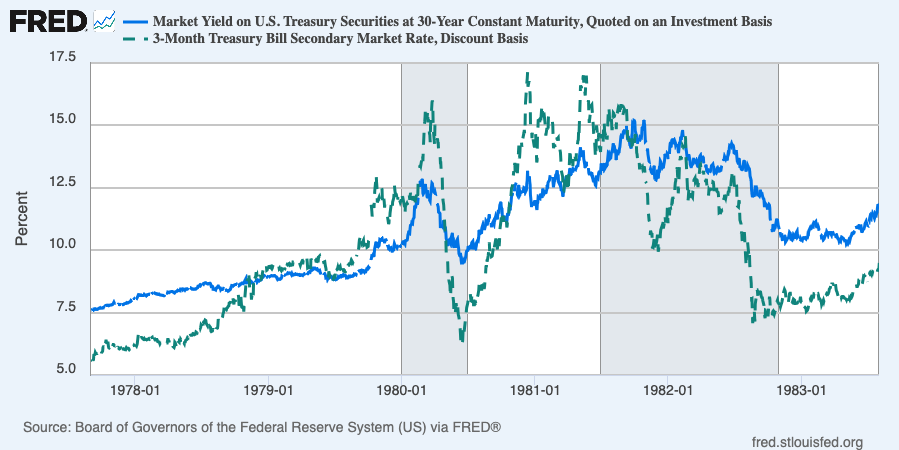
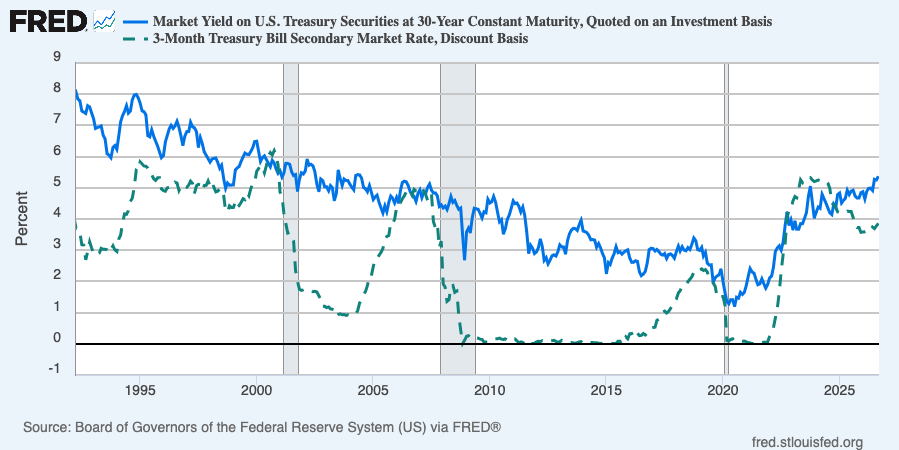
This investment strategy made a lot more sense when long-term Treasury bonds paid 14% than they did when rates dropped down under 3%.
The result was a lot of criticism. But a lot of that criticism was misguided. The point of the FIRE investment strategy was not maximum return on your investment portfolio. The point was to generate a reliable stream of income that matched your spending.
If I remember the numbers correctly, Joe Dominguez got his spending down into the $6000-a-year range. If you could live on that, and could earn 14% on your investments, you probably didn’t even need $100,000 invested in T-bonds to cover all your spending and have enough of a surplus to reinvest against inflation.
Still, between the great financial crisis (call it 2007) and the end of the pandemic (call it 2022), the strategy didn’t work at all. For much of that period, the real yield on long-term Treasury securities was below 2%. It was often below 1%. So the revision published in 2018 advocated for a much more traditional strategy of investing in a blend of stocks and bonds. I haven’t checked the numbers, but I’m sure that strategy did much better than the “only long-term T-bonds strategy” would have.
I wanted to write just a little here, advocating for that old investment strategy, now that interest rates are getting high enough to make it somewhat more tenable, because the blended-stock-and-bond strategy loses something: It loses the absoluteness of having a stream of income that covers your expenses.
Think of it this way. It would be pretty easy to come up with an investment portfolio that beats T-bonds 85% of the time. But if 15% of the time it fails to produce a stream of income that covers your expenses? Well, then you’re not financially independent, and you’re not ready to retire early.
That’s what the T-bond strategy offered, and I’m glad that interest rates are getting high enough to make it seem a little more reasonable once again.
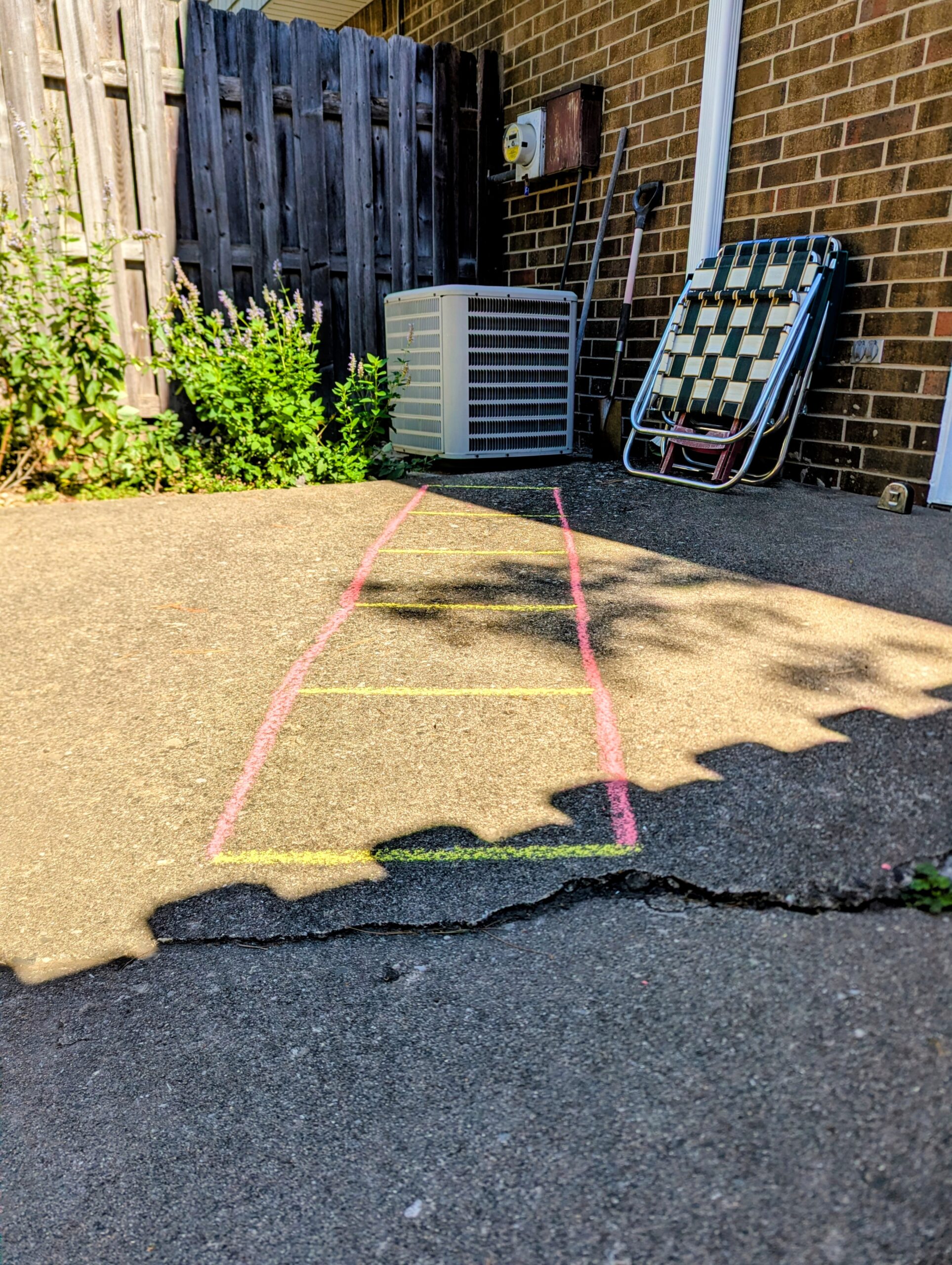
I’ve long thought some agility ladder training would help with my sword fighting. But never having trained with one, I hesitated to buy one. (Not so much for the expense—they’re cheap enough—as for having yet another thing to find space for, store, and keep track of.)
Instead I bought some sidewalk chalk and drew one. These squares are 18 inches each way which seemed kind of average. But a bonus of the chalk version is I can change it every time, if I want to.
Of course, as soon as I drew it, the dog wanted to participate.
Another bonus: although we have several nice days coming up, I know I need to start using it immediately, because it will get worn away or washed away soon enough.
Now I’m studying agility-ladder stepping patterns.
We took poor Ashley to the vet yesterday for her annual check-up. She got six vaccinations, including her next 3-year rabies shot and her 3-year distemper shot, along with all the other routine vaccinations that she needs to be able to be boarded when we go on trips. Neither the exam nor the shots seemed like a big deal, but the aftereffects of the vaccinations seem to be making Ashley feel terrible. She was so achy this morning, she couldn’t come down the stairs!
I gave her an aspirin (in some peanut butter), and that seemed to help. Then I took her out for very short versions of her usual two morning walks.
Unlike other dogs I’ve known, who seem to want to be left along when they don’t feel well, poor Ashley seems to want to be comforted. Despite my demonstrated inability to fix the weather, Ashley seems to have considerable confidence that I can fix it when she’s feeling poorly.
After a gap during which I quit following numerous friends, acquaintances, fellow writers, etc. due to a collapse of my RSS feed reader, I have gotten set up with a new feed reader, and am beginning to catch up with some of those feeds. By pure good fortune, one of the first posts by Marissa Lingen after I got back to her feed was the announcement of her new novella A Dubious Clamor.
What a glorious book! It is dense with charm, whimsy, fantasy, song, excitement, danger, and more modest amounts of intrigue and sword fighting.
Our heroine Jules, mostly recovered after breaking a terrible curse, is helping an old friend with a problem: a “cursed murderous saber in the umbrella stand.”
Sadly, that is nearly all I can say about the events of the book without spoilers. The curse, the sword, the old friend—to say much of anything about any of them would be to reveal too much.
I can say that magic in this universe is complex (as it should be). There is text, there are runes, there is song, and there is talent. Reading between the lines as best I can, I gather that someone can do magic without needing each one of these things, which means that people of small talent but much knowledge can be effective, as can people of great talent but less knowledge. There is no indication that there are going to be more stories written in this universe, but the book certainly leaves the door wide open for that, and I would certainly enjoy seeing an exploration of the diverse range of works that can be done by people with diverse mixes of knowledge, talent, musical ability, and other abilities that clearly provide an avenue for magical works, such as smithing.
Rather than try to talk yet more around possible spoilers, let me just say this is a wonderful, wonderful book, and if you like fantasy adventure stories about diverse people trying to do the important work of protecting us all, you will undoubtedly like it.
Oh, and I wanted to give a shout-out to Tempered Mettle Historical Fencing, my own local HEMA group. With plenty of gay, trans, and non-binary folk, along with allies, my experiences there meant I could just read Marissa’s book without stumbling over things like they/them pronouns. (I also know more about sword fighting than Jules, although none of my swords are magic as far as I know.)
I worked in computer security for most of my career. I worked on Unix security, then phone operating system security, then Bluetooth security. It was largely thankless work.
The issue was that no one wanted to work on a secure computer. Every security feature was a small obstacle to the user getting work done. Security features tended to get turned off or worked around. Certainly nobody was willing to pay more to buy a more secure operating system.
The secure Unix system I worked on was pretty secure. It had great security features that made it easy for users to do their work with considerable confidence that neither outsiders nor other users on their computer could hack their way in.
The federal government required that all computers purchased by anyone for any government office be evaluated to the level of security that our system offered. Over a period of years, our system was the only evaluated system available.
Guess how many we sold?
Zero.
Every government office that was buying computers asked for and got an exception to the requirement that they buy a system like ours.
That’s how much people hate security features in their computers. They slow you down. They make it harder for you to get your work done. They make your system different from other systems, so you have to learn new stuff.
It is from that perspective that I’m dismissive of AI hacking tools. Yes, they can hack computer systems, but that’s because people have preferred computer systems that are hackable. It will take a bit of time to go back and redesign and rebuild those systems with security in mind, but not long. How to do computer security is a solved problem. The knowledge is broadly distributed. It’s just a willingness to put up some minor inconveniences that’s been the obstacle to having broadly unhackable computer systems. Maybe with AI hacking tools quickly hacking into every insecure system out there (which is virtually all of them), people will finally be willing to accept the cost and inconvenience of secure systems.
At any rate, it’s no reason to regulate AI. Just a reason to enforce our regular laws.
In 1981—the last year I was in college and the first year I was working at a real job, long-term interest rates got very high. I thought this was great. (I wasn’t in the market to take out a mortgage, but rather was starting to save money.)
I actually spent a lot of time calculating how much money I’d need to save and invest in long-term treasury bonds, in order to support myself without needing a regular job. I can remember when long rates got up around 14%, thinking that, since I could live on around $20,000 a year, I’d need a base amount of about $143,000 invested, plus enough extra to cover taxes, and to reinvest against inflation, totaling perhaps $300,000.
I was ahead of FIRE (Financial Independence Retire Early), and I rather missed out on the “reduce spending” half of the idea, so I didn’t make much progress toward my $300,000 goal for the first several years. It wouldn’t be until the early 1990s that I figured that part out, and by then interest rates were a lot lower. Worse, they were falling pretty fast, making the whole thing a lot harder.
Rates kept moving against my goals pretty steadily, right through the great financial crisis in 2007, and then again during and after the pandemic in 2020. Of course inflation was falling until after the pandemic, making it seem a bit less difficult to invest enough that the return would support me even after allowing for inflation. (And, as a bonus, the Treasury started issuing TIPS, which adjusted their value to keep even with inflation, and paid their interest rate on the adjusted value. You still had to invest enough to cover inflation, but a lot of the risk and guess-work was removed.)
Now, finally, rates are moving in the right direction again. The 30-year TIPS is now paying an inflation-adjusted 3%.
The inflation calculator at the BLS says that $20,000 in 1982 is equivalent to $71,046 today. At 3% you’d need to invest $2,368,186 in TIPS to bring in that much cash. (But you wouldn’t have to worry about inflation.) Weirdly, the same BLS calculator says that the 1982 equivalent would have been $666,666. So just over double the $300,000 that I imagined would have sufficed back in the day. Which is perfectly reasonable, considering that back in the day I could have gotten 14% on my money.
Anyway, after a long period during which it was impossible to invest for a real return on a safe asset—what you want to do, if you’re doing the FIRE thing—we are finally back to having that option. It’ll be good for people like me. I think it’s good for the economy as well, even if it sucks if you want to take out a big mortgage so you can afford to buy a bigger house than you need.
I am almost completely unconcerned about the “dangers” of AI that I’m hearing about.
In particular, I’m completely unconcerned about the danger that terrorists (or bored high school students) are going to use AI to make a bioweapon. I guess the concern is that AI will be able to try thousands of changes in the time a human could try three? That is different from what evolution has been doing for two billion years in no way whatsoever.
Similar only in that it is another AI danger that’s easily ameliorated, is AI-facilitated hacking, which the AI firms want us to come up with regulations for.
The fact is, we scarcely need any new regulations at all. Just an ordinary legal structure where, if someone using AI does something improper, the legal and criminal liability falls equally on the person prompting the AI and on the company that wrote the AI.
Of course, if the harm passes through someone else who’s supposed to be taking due care (such as your bank or broker) that person also has ordinary responsibility. (So if an AI helps someone steal your retirement account, the broker holding your retirement account has to make you whole, just as if they had handed your money over to someone who hadn’t used AI. About the only AI-related regulation needed is something making it clear that the broker can not only sue the criminal who stole it, but also the AI firm whose tool was used to effectuate the crime.)
My point is that all those supposed horrible dangers are perfectly ordinary, and there is no need to do anything special at all.
What’s really interesting is why are the AI firms and AI scientists trying to gin up all this worry? Could it be that they can see that without some buy-in from governments the companies are all going to collapse in short order?
The Bureau of Engraving and Printing has a bunch of downloadable guides to tell cashiers and tellers (and ordinary folks) how to identify genuine currency.
So now seems like a good time to mention that a couple of new U.S. currency note designs came out while I was writing for Wise Bread, and each time I wrote a post or two about them:
Many Americans want fewer immigrants, primarily because they worry that immigrants are competing with native-born U.S. citizens for jobs. There are of course other reasons. Some people are racists. Some people imagine that immigrant populations will include radicals or terrorists. But I think the jobs one is the big one.
I think I see a good way to fix this particular problem. A good enough way that we probably don’t even need to have visas, or immigration checks at the borders. Most important, we wouldn’t need to have a police state with ICE agents sweeping up brown people and demanding to see their papers.
My idea is simple: add a tax surcharge—perhaps 15%—on companies, on the payrolls of immigrants, legal or not. (Plus a twist I’ll mention in a minute.)
This fixes several problems at once.
First, it means people can quit arguing about whether companies are hiring immigrants because of their skills, or just because they’re cheaper or more willing to work long hours, or whatever. If companies are willing to pay an extra 15%, they’re definitely in need of the skills. (Maybe the ideal rate is 10% or 20%. It should specifically be enough that companies will hire native-born workers if they’re capable of doing the job, because they’re cheaper than foreign-born workers after taxes. A bit of experience will show us the ideal rate.)
Second, it’ll raise wages and salaries for Americans, because even a big raise would be cheaper than hiring an immigrant.
Third, it’ll greatly reduce the cost and trouble of the numerous visa programs. In fact, we can probably just get rid of visas. Anyone can come to the U.S. and work, as long as their employer pays the surcharge.
Of course this only works if employers actually pay the surcharge—and why would they do that, if they’ve been cheating on employing illegal immigrants all along?
Well, the twist I mentioned above is to solve that: Make the statute of limitations on this tax ridiculously long. Maybe 35 years. Add on some severe penalties for non-payment as well—double the original bill, plus interest and the ordinary penalties for unpaid taxes.
Oh, and spread the liability around. If the immigrant is technically employed by a contractor, but he or she works at your site, you’re also liable for the surcharge. (I don’t expect it would be possible, but I’d like to see the CEO be personally liable for the surcharge, in cases where the corporation went bankrupt somewhere along the line.)
With a policy like this in place, employers—instead of looking the other way when they suspect someone is an illegal immigrant—now really want to know. Because they either have to pay the surtax now, or else they’re on the hook for double that money for years into the future.
I’m thinking of 35 years, because it’s long enough that the immigrants might be reaching retirement age about then. If we throw in a little incentive—perhaps 10% of the tax collected—they might be willing to report all their former employers when they’re ready to retire. Remember: They don’t owe any extra tax—the liability is all on their employers. But they can collect that little 10% as a boost to their retirement by ratting out three decades of tax-cheating employers.
I think this solves everything.
Since everyone is legal, there’s no need to worry about whether someone is “documented” or not. No need to worry about visas. No need to check anyone’s papers.
Oh, there’ll still be a need for papers—employers will want to be sure a potential employee is a citizen—there’s just no need for the police to check them. And of course, some citizens might have trouble coming up with papers. But those problems are no worse than they are already, with the bonus that they can be sorted out at leisure in ordinary courts, rather than in special immigration courts with people in detention. Citizens can show they’re native born all sorts of ways, just like they do now if they need to get a passport, but don’t have a birth certificate. Naturalized citizens have naturalization papers, plus there are other records.
Companies can copy and maintain the documentation to show that their employees were citizens, or else pay the taxes.
Nobody is “illegal.” Anybody can call the police, get a drivers license, get car insurance, send their kids to public school, go to the doctor, all without any worry that they’ll be deported. (Of course, they might not stay long, if they don’t have skills that justify their employer paying an extra 15% tax to employ them, but that’s okay too.)
We can save a bunch of money on border security, because anybody can come into the country, as long as they’re willing to compete with the locals at a 15% disadvantage.
My main interest here is in getting rid of the need for police-state behaviors on the part of the government. If everybody is legal, there’s no need for them. My secondary interest is in living in a more diverse community. I like having foreigners around. I like living among a diverse ethnic population. I think it could be awesome.
As a bonus, those extra taxes will fund quite a bit of extra government spending. Maybe even makes some headway on the national debt.
I had completely forgotten about this post, written more than 20 years ago, even though I went on to write about exactly this topic for Wise Bread for years.
This post was about the difference between playing at being poor (which gives you a bunch of psychic benefits) versus actually being poor:
Playing at being poor means living in a cheap apartment, eating cheap, healthy food prepared at home, having only one car (and not a new one), and so on. It’s really only a matter of giving up stuff–and not even all stuff. You can easily justify an extravagance or two. You might give up cable, but have a cable modem. Give up movies, but go to plays. Give up coffee shop coffee, but buy Jamaican Blue Mountain for home. In many ways, it’s the way I live now. But I try not to be smug about it. I know the difference between what I’m doing and being poor.
Being poor isn’t frugal or safe or healthy. Being poor means skipping an oil change because the alternative is skipping lunch for ten days. Being poor means living in a dangerous neighborhood. Being poor means wearing shoes that hurt your feet.
The difference is a matter of capital. Having capital is frugal. If you have capital you can play at being poor and actually live more cheaply than a real poor person. A frugal person’s car lasts a lot longer than a poor person’s. You can buy when things are cheap, instead of paying whatever price they happen to be when you simply can’t do without them any longer. Similarly, it’s safer and healthier.
Our plan is to publish science fiction and fantasy stories. You can read our planning blog here: https://blog.elegantlich.com/
We spent some time looking into creating an Illinois LLC, but are currently leaning against that idea. It would be a lot of work to get it all done and to keep the paperwork right going forward. And although (in Illinois) it wouldn’t be too terribly expensive, it would still cost a large fraction of the cost of putting out an issue of the magazine. So instead we’re thinking we just won’t call it a business, but rather just a hobby. There are some things we wouldn’t want to do if it’s just a hobby (such as sell stuff), but it’ll save us time, money, and trouble.
Our tentative cover art is by the guy who did this woodcut as well:
Normally I want to respond to every report that suggests that cannabis has very few studies backing up its effectiveness to point out, “That’s because doing such a study was illegal for most of the past century.” But this time I’ll just say, “Point to a few approved drugs with ‘real benefits’ that aren’t ‘limited to only a few conditions.'”
A major review finds medical cannabis widely overestimated and potentially risky, with real benefits limited to only a few conditions.
I’m not so sure that there isn’t some hay to be made around insisting that AI firms should be distributing half their profits to the writers whose works they stole to train their models, but I also agree with Cory that it’d be a mistake to do that in a way that broke using the internet to provide citations for dictionaries.
If you’re interested, like I am, in how and why copyright might not be the best tool for helping writers make a living writing, you’ll definitely want to read Cory’s latest at Pluralistic:
The AI copyright fight isn’t being fought to protect your wages – it’s being fought to see whether your lost wages end up in the pockets of a tech boss or a media boss.
My brother @stevendbrewer, (who shared this with me) and I are not AI natives, or even AI immigrants. I guess we’re AI foreigners. Maybe AI refugees.
(My brother warns me “People get offended when you say ‘refugee,'” so I was all, “Ooh! I’ll post that immediately!” He claims to be more an AI refusenik, while suggesting that I’m more AI-curious.)