In 1981—the last year I was in college and the first year I was working at a real job, long-term interest rates got very high. I thought this was great. (I wasn’t in the market to take out a mortgage, but rather was starting to save money.)
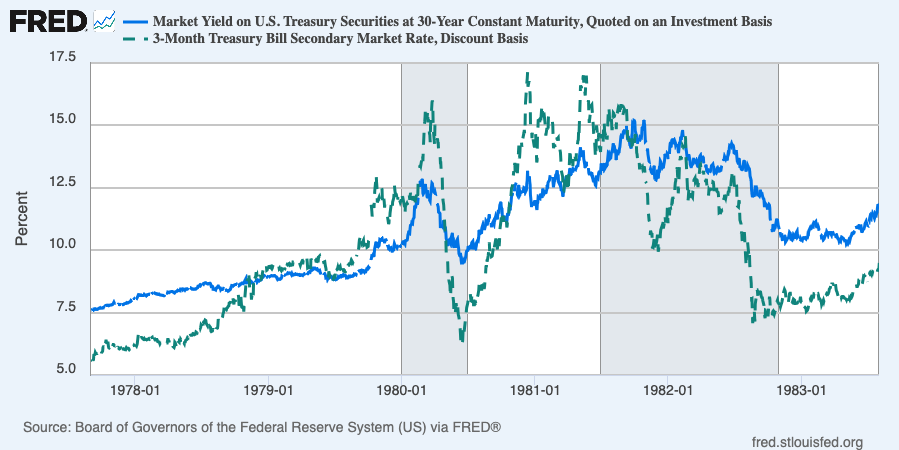
I actually spent a lot of time calculating how much money I’d need to save and invest in long-term treasury bonds, in order to support myself without needing a regular job. I can remember when long rates got up around 14%, thinking that, since I could live on around $20,000 a year, I’d need a base amount of about $143,000 invested, plus enough extra to cover taxes, and to reinvest against inflation, totaling perhaps $300,000.
I was ahead of FIRE (Financial Independence Retire Early), and I rather missed out on the “reduce spending” half of the idea, so I didn’t make much progress toward my $300,000 goal for the first several years. It wouldn’t be until the early 1990s that I figured that part out, and by then interest rates were a lot lower. Worse, they were falling pretty fast, making the whole thing a lot harder.
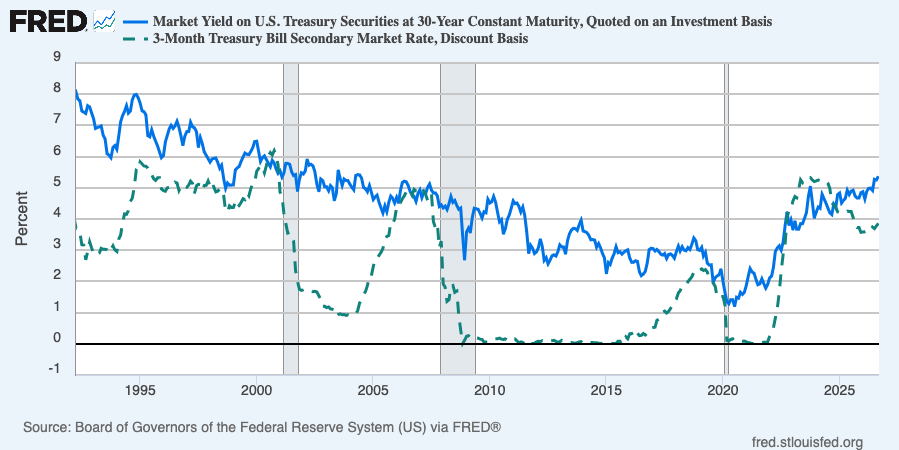
Rates kept moving against my goals pretty steadily, right through the great financial crisis in 2007, and then again during and after the pandemic in 2020. Of course inflation was falling until after the pandemic, making it seem a bit less difficult to invest enough that the return would support me even after allowing for inflation. (And, as a bonus, the Treasury started issuing TIPS, which adjusted their value to keep even with inflation, and paid their interest rate on the adjusted value. You still had to invest enough to cover inflation, but a lot of the risk and guess-work was removed.)
Now, finally, rates are moving in the right direction again. The 30-year TIPS is now paying an inflation-adjusted 3%.
The inflation calculator at the BLS says that $20,000 in 1982 is equivalent to $71,046 today. At 3% you’d need to invest $2,368,186 in TIPS to bring in that much cash. (But you wouldn’t have to worry about inflation.) Weirdly, the same BLS calculator says that the 1982 equivalent would have been $666,666. So just over double the $300,000 that I imagined would have sufficed back in the day. Which is perfectly reasonable, considering that back in the day I could have gotten 14% on my money.
Anyway, after a long period during which it was impossible to invest for a real return on a safe asset—what you want to do, if you’re doing the FIRE thing—we are finally back to having that option. It’ll be good for people like me. I think it’s good for the economy as well, even if it sucks if you want to take out a big mortgage so you can afford to buy a bigger house than you need.
