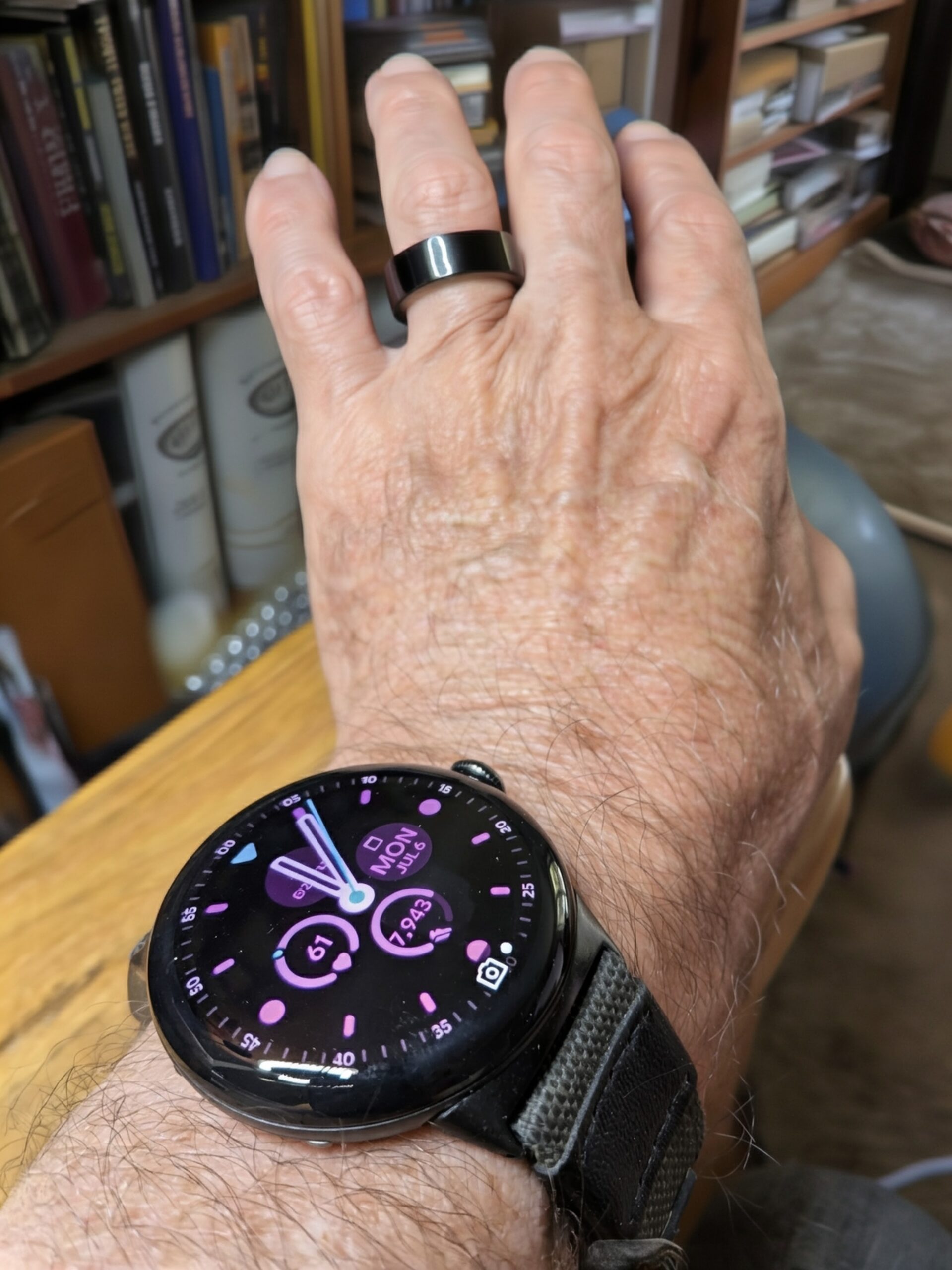
Do you use an activity tracker? I have an Oura ring, a Google Pixel watch, and a phone which runs Google Fit. All of those count my steps, and each one does some additional activity or sleep tracking. I find them all fun and interesting, so I’m always amused when yet another article comes out warning of the dangers of activity tracking.
The article at the moment is this one, sent by my brother: Five hidden pitfalls of fitness tracking, by Sahar Bakr.
I mean, sure. If you’re really foolish, you can be seriously led astray by one of these. But you’d have to be really foolish. It’s like the early days of GPS map software, where they’d be giving you directions and say, “Turn left!” but if you turned left you’d end up in a creek. Sure, you could do that, but all you had to do was look where you were going, and you could avoid it pretty easily.
Although the article has five items, there are, I think, two fundamental issues that Bakr is warning about. The larger one is outsourcing our good sense to some external device. The smaller is an excessive focus on step-count as the measure of fitness activity.
Letting a device tell you to push hard when you’re feeling crappy is just stupid. (It is perhaps somewhat less stupid to let a device tell you to take it easy when you feel great. I have several times decided to push hard because I felt great, even though one of my devices was warning me that I wasn’t fully recovered. More than once when I did that, I ended up having a crappy workout, because the device was right and I was wrong.)
With their fixation on steps (because that’s easy for a device to measure), devices have a pretty limited insight into the full scope of your movement practice. This means that they’re never going to know if your strength training is covering all the major muscle groups, or if your volume and intensity are on point. But that’s not really different from training without a device. Really, it only makes things worse if you’re so foolish as to imagine that it’s got some insight into stuff other than your steps and heart rate (or whatever else its measuring). Just like it doesn’t know enough about your strength training to provide useful advice there, it also doesn’t know much about your skills training or your flexibility training.
A lot of my training is focused on specifically increasing the sort of fitness I need for my HEMA practice. None of my devices even tries to guide me as to whether I should do less lunging practice in favor of overhead pressing practice or vice versa. (And if they did, I wouldn’t pay much attention, unless they’d started getting me to upload my sparring footage. And maybe not then.)
Getting back to the fixation on steps, the device makers want to pretend that step counts gives them some sort of deep insight into a human’s movement practice, with a one-size-fits-all target of 10,000 steps.
Weirdly, I don’t think that’s crazy. I mean, steps are by no means the only aspect of a human’s movement practice that’s important, but it’s actually not a bad proxy.
Over an evolutionarily long period, walking and running have been critical to human success. Running and walking were key to our successes in both hunting and gathering, and probably led directly to our big brains.
All three of my devices count steps. All three track walking and running. (They all try to track other activity—cycling, swimming, gardening, housework—but do so pretty poorly. Walking and running, though, they pretty much have nailed.)
In my mid-20s I was working in an office, but getting out to hike at every opportunity, which didn’t come frequently enough. I remember thinking, “If only I could get out and hike a few miles every day! I’d be in great shape!” That turns out not to be true, but it’s not completely false either.
My point here is simply that step counts are by no means a terrible proxy for one’s overall activity level, and 10,000 steps is by no means a stupid target—it’s mildly ambitious, without being out of reach for anyone with a reasonable level of fitness and some spare time. (I admit that I might well think this because I’m a weird outlier. I’m a walker from way back. I’m retired, so I have all the time in the day to walk if I want to. And I have a dog who likes to walk a lot. The upshot is, my daily steps hit 15,000 nearly every day.)
All of which is to say that I find these devices useful. In particular, they’re good at observing that I’m not fully recovered, meaning I should take it easy, even if I’m feeling okay. I find them (mildly) motivating, in that I pretty much never fail to hit 10,000 steps (unless I’m sick, the dog is sick, or the weather is terrible). I find them somewhat entertaining, especially when their praise is so for stuff I consider pretty minimal. (“You’ve met your activity goal for the day!” My Oura ring will say at 10:00 AM.)
In any case, I find them quite harmless. They don’t make me feel anxious or shamed. I’ve seen no sign that they are prompting disordered eating. I’m amused by their fixation on step counts, but not troubled by it. (I occasionally miss my 10,000 steps, usually when I’ve spent the day sitting in a plane, train, or car. I am not bothered when my devices observe that this is the case.) I care deeply about getting in my mobility work and my strength work, even if the devices don’t track it adequately. I take great joy in my movement—click any of the tags over there with “movement” in the name and find yourself taken to dozens of places where I’ve celebrated my movement practice, starting from before I had any devices, and continuing to this day. Finally, I am merely amused if my device dings me for not doing enough, as my Oura ring does if I sit for more than 50 minutes. (In fact though, these past few years, I can only barely sit still that long anyway.)
The key paragraph from the article:
For users, the first shift is to treat tracking as information rather than instruction. A watch can tell you what it has measured. It cannot tell you what your body needs today.
I mean, I know I’m a movement weirdo, but really? Who would do anything else?
