My brother and I have finished reading all the stories submitted for the inaugural issue of Elegant Lich, and are now making a second pass to identify which ones we want to publish.
It is great fun!
Once again I was careless in marking stories for inclusion in the newsletter, and there doesn’t seem to be anyway to fix it. Even though I can still add this text, I can’t add extra posts that hadn’t been marked when the newsletter draft got generated.
So, go ahead and visit my site and look at the top five or six posts, if you’re interested.
Sidewalk-chalk agility ladder
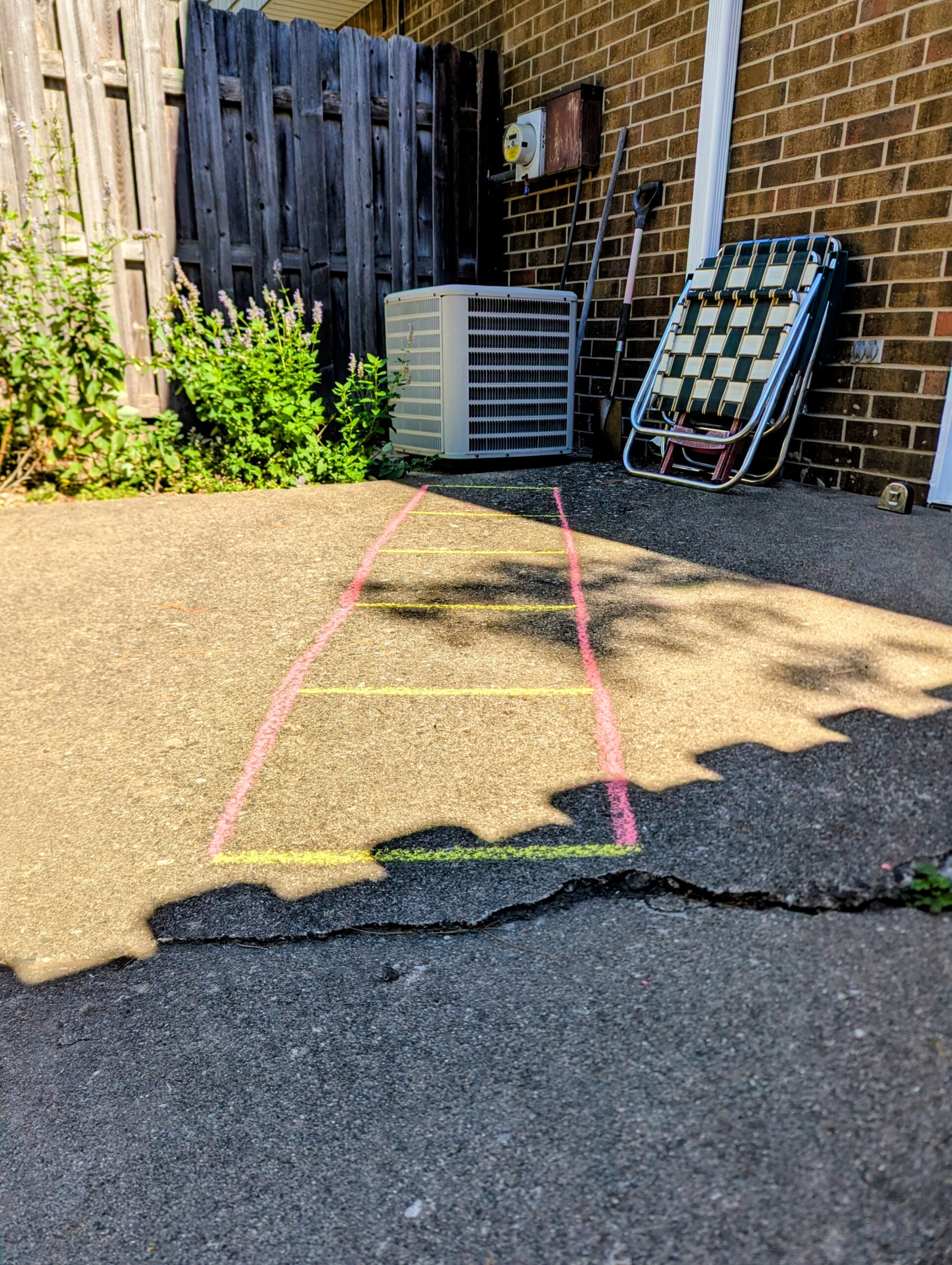
I’ve long thought some agility ladder training would help with my sword fighting. But never having trained with one, I hesitated to buy one. (Not so much for the expense—they’re cheap enough—as for having yet another thing to find space for, store, and keep track of.)
Instead I bought some sidewalk chalk and drew one. These squares are 18 inches each way which seemed kind of average. But a bonus of the chalk version is I can change it every time, if I want to.
Of course, as soon as I drew it, the dog wanted to participate.

Another bonus: although we have several nice days coming up, I know I need to start using it immediately, because it will get worn away or washed away soon enough.
Now I’m studying agility-ladder stepping patterns.
Investing for FIRE in (and after) 2026
The ur-text for the FIRE movement (Financial Independence Retire Early) is Your Money or Your Life by Joe Dominguez and Vicki Robin. I wrote a review of the book back in my Wise Bread days, so I won’t repeat that here. Rather, I want to take a look at the book’s investment strategy. Because many things investment-related changed rather dramatically between 1992 when the book was originally published, and 2018 when they brought out a revised edition, and now things have changed again.
The book began as a series of in-person seminars, that turned into a workbook with a set of audio tapes, back in the 1980s. Their investment strategy reflected those times. See my post on how my own investment strategy grew out of exactly that period.
At its most bare-bones, the original investment strategy was quite simple:
- Live very frugally
- Invest your surplus in long-term Treasury bonds
- Track your spending and your investment income
- When your investment income exceeds your spending: Congrats! You’re done.
This investment strategy made a lot more sense when long-term Treasury bonds paid 14% than they did when rates dropped down under 3%.
The result was a lot of criticism. But a lot of that criticism was misguided. The point of the FIRE investment strategy was not maximum return on your investment portfolio. The point was to generate a reliable stream of income that matched your spending.
If I remember the numbers correctly, Joe Dominguez got his spending down into the $6000-a-year range. If you could live on that, and could earn 14% on your investments, you probably didn’t even need $100,000 invested in T-bonds to cover all your spending and have enough of a surplus to reinvest against inflation.
Still, between the great financial crisis (call it 2007) and the end of the pandemic (call it 2022), the strategy didn’t work at all. For much of that period, the real yield on long-term Treasury securities was below 2%. It was often below 1%. So the revision published in 2018 advocated for a much more traditional strategy of investing in a blend of stocks and bonds. I haven’t checked the numbers, but I’m sure that strategy did much better than the “only long-term T-bonds strategy” would have.
I wanted to write just a little here, advocating for that old investment strategy, now that interest rates are getting high enough to make it somewhat more tenable, because the blended-stock-and-bond strategy loses something: It loses the absoluteness of having a stream of income that covers your expenses.
Think of it this way. It would be pretty easy to come up with an investment portfolio that beats T-bonds 85% of the time. But if 15% of the time it fails to produce a stream of income that covers your expenses? Well, then you’re not financially independent, and you’re not ready to retire early.
That’s what the T-bond strategy offered, and I’m glad that interest rates are getting high enough to make it seem a little more reasonable once again.
Not a victory lap
I hesitate to take a victory lap regarding my predictions for the Iran conflict, and my predictions for the harms produced by AI. This post is just to say: I stand by what I have been saying.
With a bit of commentary, here’s the posts I’m standing by:
- Things are amazingly more bad than markets seem to think The fact that a considerable amount of oil is now getting through might make this seem less worrisome, but I continue to stand by my analysis. Oil is getting through at great risk, and at huge cost. I don’t see any scenario where this gets better any time soon.
- Things are still amazingly bad Not much to add here. Nothing Trump is doing (or can do) will help in the slightest.
- The supposed dangers of AI As I say in the post, I think really there aren’t any.
- “Exit through the state” could fail The single exception is that the AI tech bros could convince the government to pay them billions in taxpayer dollars to prevent a stock market collapse after the AI bubble bursts. That would be very bad, but I’m slightly hopeful we can avoid that scenario.
- Prepare yourself for the pop of the AI bubble My argument that there is an AI bubble, and that it’s one of the bad sorts (where very little of enduring value gets built, and the whole thing is financed with a lot of leverage that’s hard to analyze).
One thing that’s a little difficult just now is structuring your investments so that when the AI bubble collapses your whole portfolio doesn’t collapse along with it. That’s harder than you might think, because AI, and AI-related stuff (power generation, data center construction, real estate under data centers, lending money to AI companies, etc.) add up to be most of the S&P 500 now.
I’ve been toying with various ideas—investing in foreign companies, investing in dividend-paying stocks, investing in government bonds. I just heard a podcaster claim that really the only sectors of the economy that aren’t mostly AI-related now are maybe consumer staples and health care, which aren’t really enough to add up to a diversified portfolio. He suggested just investing in short-term government securities, and waiting for the bubble to pop. So that aligns nicely with my preconceptions.
