First day of NaNo 2.0
I got in a very good morning writing session today, starting pretty much right after second dog walk. By late morning I’d topped 1200 words. I took a break then and paused to do some on-line chatting with my brother, some morning exercises, and take the dog out for third walk just before lunch.
I stopped at a point where I’m not quite sure what comes next. This is widely considered a bad move, because it makes it harder to get back to writing. Still, sometimes it happens, and it’s worth having a couple of tricks for getting going again.
Here’s one: skip ahead and write a “candy-bar scene.”
A candy-bar scene, if you don’t know, is a scene that you already know is going to be fun to write. A scene where a character does something wonderful, or something wonderful (or wonderfully awful) happens. A scene where a reversal happens that’s both completely unexpected and inevitable. A scene that makes you reinterpret the whole story up to that point.
Besides being fun to write, hopefully a candy-bar scene is also fun to read.
Arguably, your whole book should be nothing but candy bar scenes. In practice that’s hard to do, but it’s certainly something to keep in mind.
Anyway, I had a candy-bar scene in mind as something I could write when I got back to writing this evening. In fact though, I picked up exactly where I left off, adding a good bit to the scene that had petered out on me in the morning session. (I can probably credit thinking during a dog walk for this.) Then I did go on to write the first bit of the candy-bar scene I’d had in mind. But only little bit of it, leaving a nice ragged edge where I know what happens next, all ready to pick up tomorrow.
It’s a nice feeling.
Another nice feeling is that I hit the target word count. (That is, the 1667 words per day I need to average, if I’m going to hit 50,000 words by the end of November.) I’m not actually very fixed on hitting the word count, but I figured I give it a try, at least for a little while.
For the morning writing session I wore my writing vest—the moleskin vest Jackie made me years and years ago, that I took to Clarion with me, and have made a point of wearing when I wanted to crank out some serious words. It worked great.
I didn’t get a photo, but I’ll try to get one later.
This evening I switched to my wool Filson vest, which I’d worn for warmth when I took the dog out for fourth walk, and I got a sort-of picture of me wearing it, sitting with my dog.
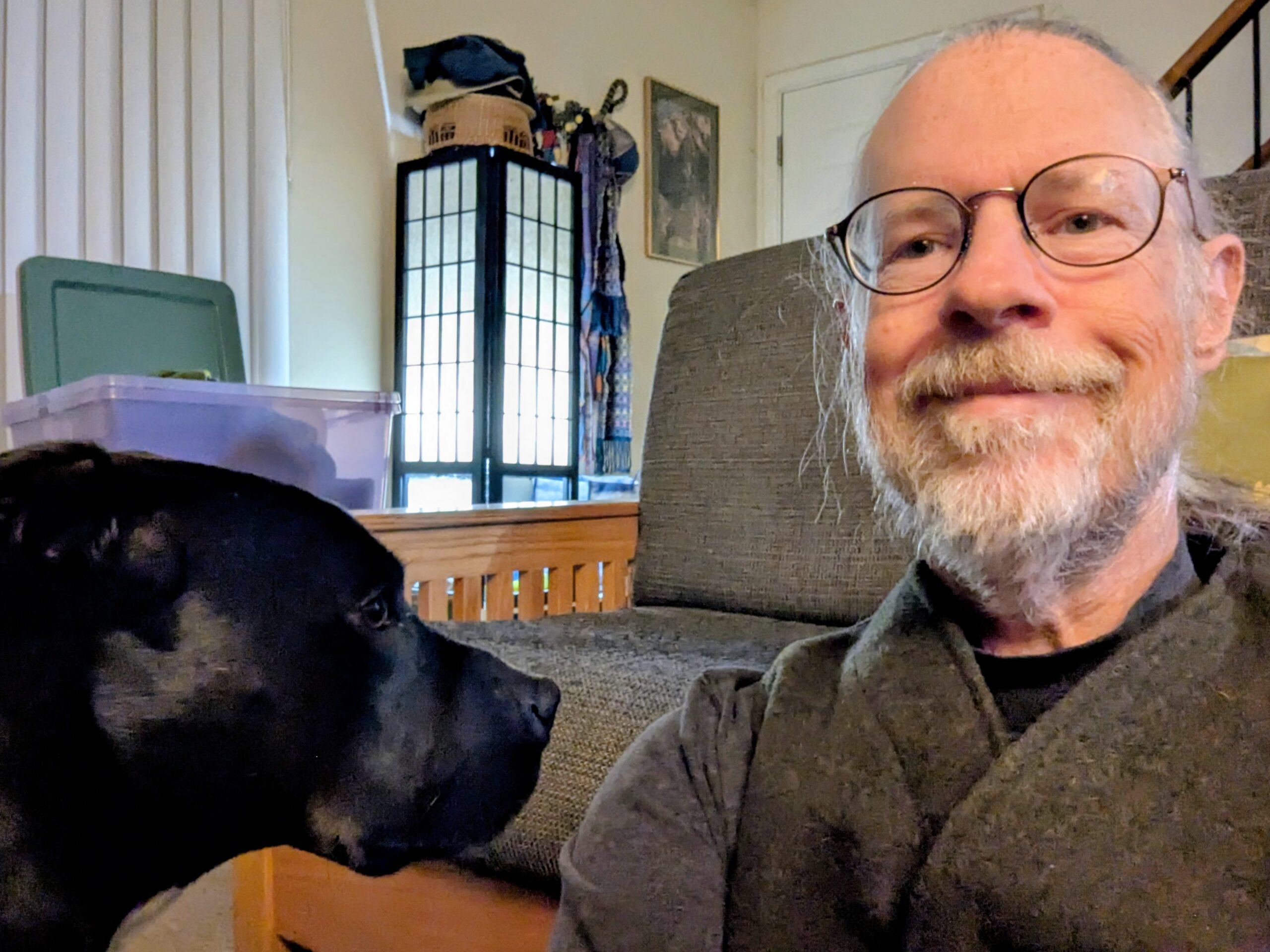
It’s a little hard to see in the photo—the green vest looks almost the same color as my grey mock-T—but this is the same vest that Joe Pickett wears in the C.J. Box stories. It is cozy and durable.
SFWA Worlds of Giving
Invited by my brother (SFWA’s board secretary), I just attended the kick-off meeting for SFWA’s Winter Worlds of Giving.
If you’re a writer, and especially if you’re a SFWA member, check out that link! They’re asking writers to make a public statement of their “creative interests, and the broad strokes of what you’ve got on the go.” Doing so will put you in a group of people who are going to be doing some pretty cool stuff over the next three months.
Sword fighting training not so good for writing
Sundays are the day I still manage to do some HEMA training. I used to go three times a week, but had to cut way back after I hurt my elbow. Now it’s just Sundays, because Sunday is the day my group does a sword-in-one-hand class, which is gentler on my elbow. We usually train dussack or rapier.
My plan for today was to get as much writing done in the morning as I could, then go train sword fighting, and then squeeze in a bit more writing in the late afternoon or evening. But, as often happens, things happened. My brother invited me to attend the kick-off meeting for SFWA’s Winter Worlds of Giving event, so that was most of an hour on zoom. Then my usual cocktail hour with my brother and my mom. Then walking the dog. Then an episode of The Diplomat with Jackie. Then another episode of The Diplomat with Jackie. And now I’m just too tired to get any more writing done.
So, it’s a good thing I got in that morning session, which got me 551 words.
Tomorrow I’ll be back at it.
Setting the bar (for exercise) low
I walk a lot. Because I have a dog, and want to be sure my dog gets the exercise it needs, I take a truly inordinate number of steps per day. (Wait just a moment while I check my Fitbit…) Last week I averaged 14,036 steps per day. The previous week I averaged 17,197 steps per day. Those weeks are quite typical for me; I don’t average much under 15,000 unless I’m sick or the weather’s really bad.
So, when I saw the news recently that walking “3,000 to 5,000 steps per day can help to stave off mental decline,” I’m like, “Okay? Great.” Taking 5,000 to 7,500 steps per day seems to stave off Alzheimer’s disease by around seven years.
I mean, that’s great. Staving off Alzheimer’s disease by 7 years would probably cut the incidence of the disease by close to half (because people would die of something else first).
But really? I mean, yes, my inordinate walking takes a lot of time that most people don’t have. Back when I was working a regular job I’d try to get “enough exercise,” and that generally topped out at an average of a little over 100 minutes per day—and that much only in the summer, and that high only because I’d average in a 3 or 4 hour bike ride over the weekend. Now I probably spend close to 150 minutes per day just walking the dog. I recognize that almost nobody’s got time for that.
And, yes, walking in particular depends on capabilities that not everyone has. Lots of people old enough to worry about Alzheimer’s have bad knees or bad hips or bad feet or bad hearts or bad lungs. Maybe their endurance is very low. Maybe their balance is poor enough that walking is a risk.
But it doesn’t need to be walking. Walking is just easy to measure with a wearable device. Any sort of exercise will do the trick. Lift weights. (They don’t have to be heavy weights, as long as they’re heavy for you.) Ride a bike. Ride a stationary bike. Row. Use a rowing machine. Play almost any sport. Dance the night away.
Related to this, only in terms of how low the bar is set to do an enormous amount of good, a different study looked at whether walks needed to be long in order to provide the benefits, or whether cobbling together a number of shorter walks to add up to the same number of steps was just as good. It turns out longer walks are better. (Risk of being diagnosed with cardiovascular disease within 9.5 years dropped from 13% to around 4–8%.) But the dividing line in the study was that walks of at least 10–15 minutes counted as “long” walks, versus short walks of less then 5 minutes.
If you can walk 5 minutes, I’ll wager you can work up to walking 15 minutes in a very short period of time. And the evidence is now pretty clear that it’s worth doing.
Get some exercise. The bar is pretty low for making a big difference.
A hero trying to achieve great things
One of the flaws of my fiction writing is that my heroes tend to be quiet people, eking out a meager existence during hard times. This is largely due to my perspective on the future, which is that hard times are very likely coming, combined with my own cautious nature, projected onto my heroes.
The problem is that quietly eking out a meager existence in the face of hard times doesn’t really make for an exciting story.
What tends to make for an exciting story is a hero trying to achieve great things.
So, for my novel, I’m trying to lean into this idea. As this is not my natural inclination, I hadn’t really laid the groundwork for this in my first few thousand words, but I have now gone back and layered in a tiny bit of backstory that shows the hero as someone who has tried to achieve great things in the past, and as the sort of person who might do so again in the future.
And I think I did it without violating the rule about minimizing rewriting. During a November novel-writing month you want to move forward as fast as possible, leaving any rewriting for after there’s a first draft. Essentially everything I did was adding new scenes between existing scenes that advanced the action while providing a bit of backstory.
The writing isn’t going very fast. I’ve been averaging a bit under 700 words a day, which is a bit less than half of what I’d need to hit 50,000 by the end of the month. Which is okay, because hitting 50,000 words is a goal, not a moral committment. And I’m thinking things will pick up, once the “striving to achieve great things” mojo starts working.

Mental health, not economics
My brother suggests that I had missed the point in my recent post, where I claimed that being depressed about work is nothing new, and that finding work worth doing was the solution.
I beg to differ.
I was not claiming that things are not way worse. Obviously, the way people are hired, managed, and required to do their tasks are way worse than they used to be. Nor am I claiming that finding “work worth doing” will solve the financial or economic problems—it won’t make it easier to pay the rent or put food on the table.
My claim is that it will help the mental health issues of dealing with late-stage capitalism.
Finding, and doing, work that’s worth doing will make everything else about your life better.
It’s why I was such a strong advocate for frugality and simplicity during those years writing at Wise Bread. Maybe you can find a way to earn more, and maybe you can’t, but anybody can find a way to spend less. And if you spend less, you can focus more on the work that’s worth doing, even if it doesn’t pay as much as the the wretched, soul-destroying work that’s ruining the lives of another generation of workers.
Starting to see where it’s going
Yesterday was a serious-thinking day on my novel, rather than fingers-on-keyboard day. I got zero words, but I figured out who the antagonist is. (I’d thought I had one already, but I’d realized he wasn’t going to work. I needed someone further away, and someone more. . . not more formidable, because the guy I’d been thinking of is plenty formidable, but more. . . Dangerous.
Anyway, after yesterday’s thinking, I got a good bit of writing done today.
It’s nice to be here, because I think I can see several more days of cranking out prose based on what I’ve just figured out, whereas for a couple of days there I was just creeping along, making little tweaks around the edges, because I didn’t know where it was going to go next. Now I do.
Prepare yourself for the pop of the AI bubble
I don’t usually worry much about investment bubbles. There have been a lot of them over the past few hundred years, and most of them (railroads, telegraph, dotcom…) were expensive disasters largely only for the people who invested in them. Some though, such as the Great Financial Crisis of 2007–2009, were expensive disasters for lots of other people as well. So it’s worth thinking a bit about whether the current AI bubble is of the former sort or the latter—and how to protect your finances in either case.
Bad just for investors
One big difference between bubbles that are going to be wretched for everybody when they pop and those that’ll end up mostly okay except for the foolish investor’s portfolio, is whether the excess investment got spent on something of enduring value.
For example, railroad lines got enormously overbuilt in the 1840s in the UK and in the 1880s in the US, leading in both cases to a stock market bubble, followed by a stock market crash and a banking panic. But (and this is my point), the enormously overbuilt railroads were of some value. As the firms went bankrupt, the people who had over-invested lost a lot of money, but the railroad tracks, rights-of-way, and rolling stock all still existed. The new firms that got those assets, free of the excess debt, were often viable firms that went on to be successes—hiring workers, providing transportation, and eventually providing a return to the new investors. The people who got screwed were the old investors. (And not even all of them, as the original investors often saw the overbuilding happening early and sold out just as the clueless people who knew nothing about running a railroad, but just saw stocks soaring and wanted to get in on it, started piling in.)
Much the same was true of part of the dotcom bubble. A lot of money got spent on a lot of things. To the extent that it was spent on buying right-of-way and burying fiber, there was something of enduring value that ended up owned by somebody, making it one of the less-bad bubbles.
The key to avoiding catastrophe in bubbles of this sort is largely just a matter of not investing in the bubble yourself.
Bad for the economy
But some bubbles have produced horrible, wretched, prolonged difficulties for the whole economy. The other part of the dotcom bubble, besides the dark fiber build-out, was the bubble in companies with no profits and no prospect of ever having profits, whose stock prices went up 10x based on nothing but a story that sounded compelling until you thought about it for 10 seconds. As usual, that ended up being very bad for the people who invested in those companies, but it also was bad for the whole economy, because when those firms went bankrupt, they left behind nothing of enduring value.
The result was that the imagined wealth of those companies just vanished. The stock market went down, which was bad for (almost) everybody, and it produced a general economic malaise, because post-dotcom crash it became hard even for legit companies with real assets, a real profit, and a real business plan for growth, to raise money, which made actually producing that growth much harder.
Really bad for the economy
There is, however a step beyond just pouring a bunch of money into a bubble that doesn’t actually produce anything of enduring value, like a fiber optic network or a railroad. That’s when the money is raised with leverage (i.e. debt).
The 1929 stock market crash was a rather drastic example. People invested in stocks not because there was an underlying business that was worth what the investors were paying for it, but purely because the stocks were going up. That might have been okay in other times, but stock brokers had recently started allowing ordinary people (as opposed to just rich people) to buy on margin—where you just put up a fraction of the price of the stock you want to buy, and the broker lends you the rest.
In the 1920s you could buy on 90% margin, where you only put down 10% of the price of the shares. That meant that, if the stock price went down by just 10% your whole investment was wiped out, and the broker would sell you out to raise money to pay off (most of) the loan. And of course, all those sales into a falling market produced more losses, leading to the crash.
Since the 1930s you could only buy stocks on 50% margin, making it much less likely that your broker will sell you out into the teeth of a general stock market crash—although it can still happen.
Bubbles with leverage
A great example of a bubble with leverage is the Great Financial Crises of 2007. (Most people date it from 2008, because that’s when Lehman Brothers collapsed. I date it from 2007 because that’s when my former employer closed the site where I worked and I ended up retiring rather earlier than I’d planned.)
That was a particularly bad bubble. A whole lot of money was raised, with leverage, to buy housing. But very little of the money ended up being spent to build more housing (which would have been something of enduring value that would have lasted through the subsequent collapse). Instead, the money was spent bidding up the prices of existing housing, which then fell in value after the bubble popped.
So we had two of the classic producers of bad bubbles: Nothing of enduring value created, and leverage. The whole things was made even worse by the structure of the leverage in question.
This is getting rather far from my main point, so I won’t go into much details, but to raise the large amount of money that was going into houses, the rules on housing market leverage were being eased over a period of time. It used to be that you had to put 20% down on a house. Then you still had to put 20% down, but only half of it had to be cash, with the other half being funded with a second mortgage on the property (at a higher interest rate). Then they started letting people put just 3% down. Then they started letting people with good credit put nothing down. Then they started letting people with no credit put nothing down. At the same time, “structured finance” obscured just how risky all those mortgages were, meaning that when the bubble went pop lots of “mortgage-backed securities” ended up being worth zero.
Which kind is the AI bubble?
This brings us to the current AI bubble. A whole lot of money is pouring into building two things:
- Data centers (buildings filled with computer chips of the sort used to train and run AI models)
- Large language models (non-physical things that are basically just a bunch of numeric weights of a bunch of tokens which can be used to produce streams of plausible-sounding text)
Each of those may have some enduring value.
Data centers will have some. They will probably have a lot less than a network of fiber optic cables, which can be buried and will have value for decades with minimal cost or maintenance. Since newer, faster chips are coming out all the time, a data center is well behind the cutting edge as soon as it’s finished. Plus, training or running an AI model runs those chips hard, meaning that they probably only last a couple of years (due to thermal damage on top of regular aging).
Large language models probably have even less enduring value, because so many people are training new ones all the time. People are always trying to make them bigger (trained on more data) while also making them smaller (so they can run without a giant data center). All that means that your two-year-old LLM probably isn’t worth what you paid to build it, and a four-year-old LLM probably isn’t worth anything.
That’s how things looked a year or so ago—a perfect example of a bubble that would burn the people who sank money into it, but leave the broader economy untouched.
Sadly, that’s been changing.
First, the structure of the leverage has been changing. It used to be rich people and rich companies were building data centers and hiring software engineers to build LLMs. But lately that’s been getting screwy. Those large companies are raising off balance-sheet money with Special Purpose Vehicles (small companies that big companies create and provide some capital to, that then borrow a bunch of money to make something, with the loans collateralized by the things they’re making—but importantly, not an obligation of the big company that created them). Any particular SPV can blow up, if it turns out that the things it built don’t earn enough to pay the interest on the money the borrowed to build them. And large numbers of SPVs can blow up if financial conditions change to make it harder for all the SPVs to roll over their debts as they constantly have to keep their data centers running.
Second, they’re also engaging in weird circular investing and spending arrangements, where company A buys stock in company B which then turns around and pays all that money back to company A to buy chips, letting company A treat it as both income and an investment, while company B can pretend it got its chips for free.
Finally, there’s all the non-financial obstacles that may well throw a wrench into the whole thing. The fact that LLMs are all built on copyright violations. The fact that running data centers requires huge amounts of power and water (that has to be produced and paid for). The fact that producing that water and power brings with it horrible environmental impacts.
What to do
So, if AI is a bubble, and its one of the bad sort that will produce a panic and a recession when it pops, what should you do?
There are a lot of little things you can do that will help. I wrote an article with suggestions at Wise Bread called Are your finances fragile? It talks about what financial moves you can take to put yourself in a better position if there’s a general financial crisis. (If you’re interested in my writing about this stuff more broadly, I wrote a overview of my perspectives on personal finance and frugality called What I’ve been trying to say, that includes a bunch of links to other of my posts at Wise Bread.)
Besides that general advice, there are also a few things to strictly avoid. In particular, strictly avoid thinking that you can find some very clever investment strategy that lets you make money off the popping of the bubble. Yes, after the fact there will be some investments that make a lot of money, but no amount of keen insight will let you find and make those investments, as opposed to the thousands of very reasonable-seeming investments that will blow up just like all the rest.
Along about the end of the Great Financial Crisis I wrote an article called Investing for Collapse, which explains why any such effort is pointless. It holds up pretty well, I think.
Short version? Avoid debt. Keep your fixed expenses as low as possible. Build a diversified investment portfolio that limits your exposure to the most obviously stupid investments, but doesn’t do anything too weird or wacky in an effort to get them to zero—it’s pointless, and will probably do more harm than good.
Good luck when the AI bubble pops!
Glorious new Thibault book preordered
This summer, while in Chicago for other reasons, we went to the Art Institute. I made a point of tracking down the room with the arms and armor, where I found, among many other things, a copy of Thibault’s Academie de l’Espée.
The picture above gives you and idea of the fabulous (and fabulously detailed) engravings, but look how big the book is! I mean, it’s half the length of a sword!
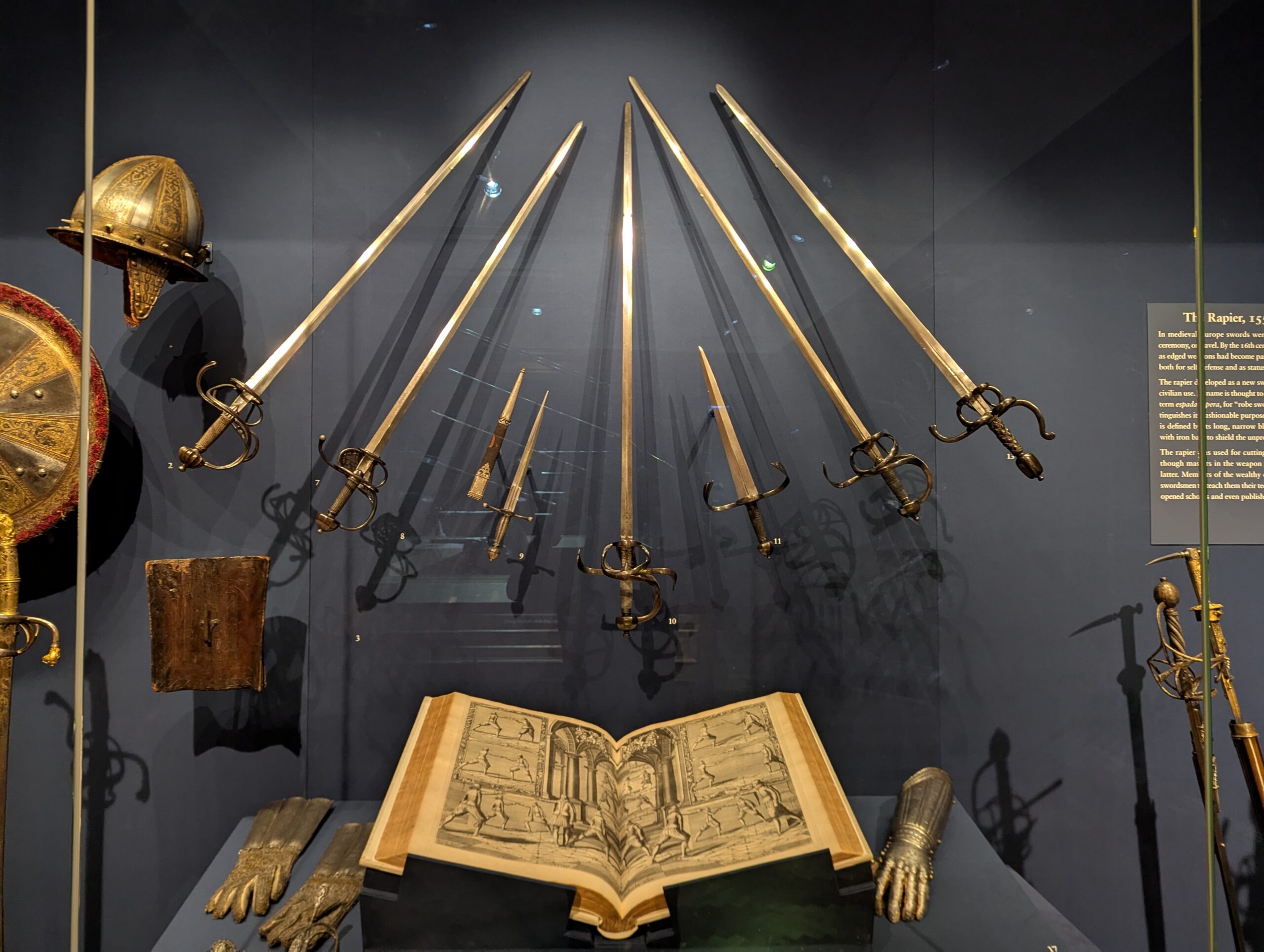
So, I was delighted to discover that HEMA Bookshelf has a plan to publish a book with these images, “the first time this art has been published at close to full size since 1668.”
Read about the project here: The Thibault Project. While you’re there, go ahead and pre-order a copy yourself. I mean, it’s only money. Oh, and way more bookshelf space than I have available. But I’ll fit it in somewhere.
Better than “gameification” of exercise: “storyfication” of exercise
I have long had mixed feelings about gameification, where you use the structures that underlie games (like points, achievements, badges, etc.) to motivate yourself to do the things you already know you want to do. I’m dubious about it, but at the same time, I do find myself motivated by such structures, which makes it very tempting to use them. (For exercise in particular, but really everything.)
Just lately, I’ve started thinking about a modest alternative: storyfication, where you use the structures of fiction to motivate yourself to do whatever it is you want to do.
Essentially, you tell yourself a story about what you’re doing, rather than making a game out of it.
Plenty of people do related things. There are several popular YouTube fitness channels that are all about using anime stories and situations, or superhero stories and situations, as inspiration for working out. (See for example JaxBlade, The Bioneer, or Kevin Zhang.) Some of them are primarily about aiming for the aesthetics of anime characters, but some reach into the story lines of specific anime. And some—the most interesting ones—use the underlying structure of anime or comic-book type stories as workout inspiration.
I’ll rough up an example here. Any story structure might be worth trying, but I’m inclined to start with the Hero’s Journey story structure. I’m assuming that we’re talking about doing exercises to get fit, but the basic storyfication thing could work for anything where you need to engage in repeated actions to get better at something—learning to paint, say, or learning to play the violin.
You begin with the Call to Adventure. If we’re talking about exercise, it would be a desire to get fit. Of course, the hero always initially resists the call. (Getting fit is a lot of work that’s hard and sometimes uncomfortable.) But finally the hero (you) chooses to accept the call.
The bulk of what you’d be doing would be “traveling on the road of trials, gathering powers and allies.” (That is, consistently doing your workouts.)
Dividing things up into separate books or seasons makes good sense. It can be very useful to grind away on one or a few things (building strength, say, or building endurance, or explosiveness) for a few weeks or a few months, but you need to include occasional breaks. You might consider each week of workouts a chapter or an episode. Put six or eight or ten together, then take a break. And then, of course, return for the next volume or the next season, perhaps with a new focus.
In the Hero’s Journey structure, the next thing would be to confront evil and be defeated, leading to a dark night of the soul. I don’t see much value in writing this into your plan, but there may be value in keeping the idea in your pocket for when things go awry. And, of course, things will go awry. A major project at work or at home may take so much time you can’t fit in all your workouts. An injury or illness may derail your workouts for a time. Maybe you’ll just hit a plateau in your fitness journey.
When something like that happens, well, you can view it as confronting evil. Remember, after being defeated, you face the dark night of the soul. One thing you might do at this point is think deeply about what obstacle might be blocking your progress. In fitness there are many possibilities: insufficient volume of exercise, insufficient intensity, insufficient recovery, poor exercise selection, poor nutrition . . . . The possibilities are nearly endless, and it is often hard to know which is the real culprit.
For that reason, the next step in the hero’s journey is especially appropriate: You take a leap of faith. Even though you can’t know what’s the best choice, you make a choice anyway. Maybe you ease up on intensity and focus on recovery. Maybe you double-down on exercise volume. Maybe you focus on your diet.
Whatever you choose, you can think of it as confronting evil again. And in a proper hero’s journey, this time are victorious.
Go ahead and write this part into your plan.
The final stage of the Hero’s Journey is that the student becomes the master. Again, there’s no need to write that into your plan. But it is entirely possible that having some success with storyfication will make you feel like sharing your insights with others, which is really what being a master of something is.
I generally view both gameifcation and storyfication as essentially neutral—neither good nor bad, except to the extent that the thing being motivated is good or bad.
Perhaps related to this is a word I’ve just learned:
“hyperstition.” The term, coined by “accelerationist” writer Nick Land, describes the belief that one can manifest future realities by telling compelling stories, and that prophecies become self-fulfilling through repetition and virality.
— https://www.thenerdreich.com/silicon-valley-apocalypse-capitalism/
Telling yourself a compelling story can definitely help you put in the time and effort to achieve your goals, just like the structures that underlie games can do the same.
Is anybody else out there interested in using story structure to motivate themselves to exercise (or do something else)? Anybody already doing so, and able to provide some first-hand experience?
Let me know! (See my Contact page for many ways to contact me.)
